The best Mulholland Drive viewpoints are the seven scenic overlooks that the Mountains Recreation & Conservation Authority (MRCA) maintains along the parkway. For the classic Los Angeles postcard, start at the Jerome C. Daniel Overlook above the Hollywood Bowl (7036 Mulholland Drive). For the San Fernando Valley and an easy walk, go on to the Universal City Overlook and the Nancy Hoover Pohl Overlook. This guide tells you what each stop gives you, where to park, what to skip, and how to stay safe on a road that rewards slow driving.
TL;DR
- Mulholland Drive has seven MRCA-maintained overlooks. The east end, above the Hollywood Bowl, is the one for the Hollywood Sign, downtown and the L.A. basin.
- The Valley-side overlooks (north side of the road) are far easier to enter and leave than the ones on the south side, because you avoid left turns across oncoming traffic.
- Overlooks are free and generally open from sunrise to sunset. Parking lots are small, so go early or on a weekday.
- On hot, dry, windy days, check closure notices first. Trails can close under Red Flag Warnings even when the road stays open.
- Stay on the paved sections east of the 405. The unpaved “Dirt Mulholland” stretch is not for low cars.
Table of Contents
- What you are actually driving
- The overlooks, from east to west
- Quick comparison
- The most scenic stretch
- When to go
- Driving Mulholland safely
- Add the hikes and the Hollywood Sign
- Our perspective
- Ways to see the view without driving it yourself
- A simple half-day plan
- Frequently asked questions
- Sources
What you are actually driving
Mulholland is not a single scenic road with seven photo stops. It is a ridgeline route along the spine of the Santa Monica Mountains. The Mulholland Scenic Parkway and Corridor runs 55 miles, and the 24-mile piece known as Mulholland Drive sits inside the City of Los Angeles. It starts just west of the 101 Freeway in Hollywood and climbs west through Studio City, Sherman Oaks and Encino.
The appeal is contrast. You leave one of the busiest cities in the country and within ten minutes you are on a quiet, curving road with the whole basin laid out below. Time Out describes it as a joyride above Hollywood, and that is the right mindset. Treat it as a destination, not a shortcut.
On one side you look south over Hollywood, Beverly Hills and, on clear days, the ocean. On the other you look north across the San Fernando Valley toward the mountains. Which side you stop on changes the whole view, which is why the overlooks are worth planning rather than guessing.
The overlooks, from east to west
The MRCA lists seven developed overlooks. Here are the ones most visitors build a drive around, in the order you will meet them if you start from Hollywood.
Jerome C. Daniel Overlook above the Hollywood Bowl
Address: 7036 Mulholland Drive, Hollywood.
This is the most easterly of the MRCA’s overlooks and the one first-time visitors want. The MRCA says it is positioned for views of the Hollywood Bowl amphitheater, downtown Los Angeles and, on a clear day, the ocean and Catalina Island. To the east you can pick out the Hollywood Sign and Griffith Observatory.
The overlook and the Universal City Overlook were both built in 1984, in time for the Summer Olympics. According to the Lamountains guide, it has a parking lot, drinking water and ADA access, and dogs are allowed on leash.
One tip from local guides: do not stop at the parking lot railing. The widest, least obstructed angle comes from walking up the short trail above the lot, and the extra few minutes are worth it. Of all the stops, this is also the one most likely to be busy at sunset.
Universal City Overlook
Address: 7701 Mulholland Drive, Studio City.
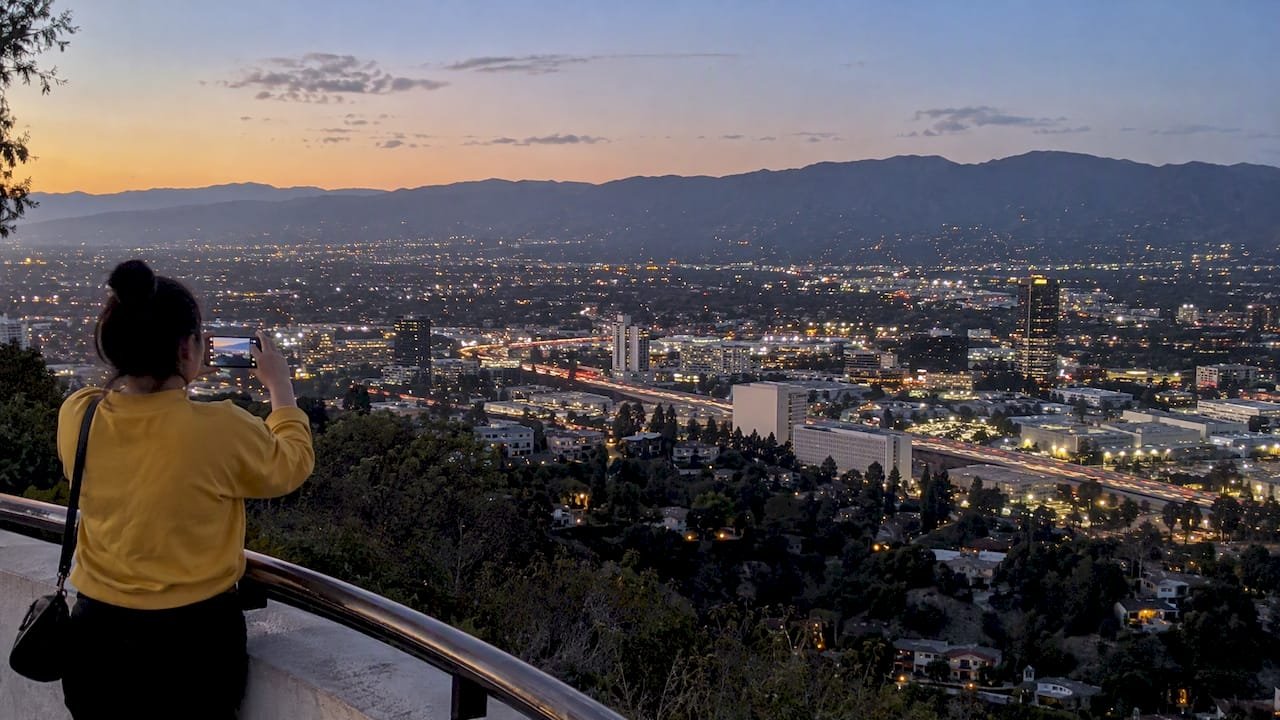
Sitting on the north side of the road, this overlook gives you views of the San Fernando Valley and the Verdugo Hills. It has a parking lot, is ADA accessible and has been used as a filming location. Because it is on the Valley side, you can pull in and out without crossing the road.
This is the stop for the sea of lights at night in the Valley and for a sense of how big the basin is. It is less iconic than the Hollywood Bowl view, but it is usually calmer.
Nancy Hoover Pohl Overlook
Address: 8401 Mulholland Drive, Studio City.
Located on the north side, west of Laurel Canyon, this overlook has Valley views, a 40-car parking lot, a physical fitness course and access to canyon trails. It is also the easiest way into Fryman Canyon Park, which makes it a good pick if you have kids or relatives who want to stretch their legs without committing to a serious hike. The Lamountains overview calls Fryman Canyon more manageable than the rugged trails further west.
Barbara A. Fine Overlook at the Summit
This north-side overlook has a large paved parking area and a short trail to viewpoints over the upper fork of Fryman Canyon, the San Fernando Valley, the Simi Hills and the San Gabriel Mountains. If a lot is full elsewhere, this larger lot is a useful fallback.
The rest of the seven
The MRCA’s parkway page also lists Stone Canyon Overlook, on the south side of the road, and other overlooks further west. Check the MRCA parkway page for the full list and for current notices before you go. For most visitors with two or three hours, the first four above give the best return.
Quick comparison
| Overlook | Side of the road | Best for | Notes |
|---|---|---|---|
| Jerome C. Daniel (7036 Mulholland) | South | Hollywood Sign, Hollywood Bowl, downtown | Walk the short trail for the widest view |
| Universal City (7701 Mulholland) | North | San Fernando Valley, Verdugo Hills | Easy entry and exit, ADA accessible |
| Nancy Hoover Pohl (8401 Mulholland) | North | Valley views, Fryman Canyon access | 40-car lot, fitness course |
| Barbara A. Fine at the Summit | North | Valley, Simi Hills, San Gabriel Mountains | Large paved lot, short trail |
The side of the road for Jerome C. Daniel is my reading of the view direction toward the Bowl and downtown, so confirm on arrival, and follow posted signs for turns.
The most scenic stretch
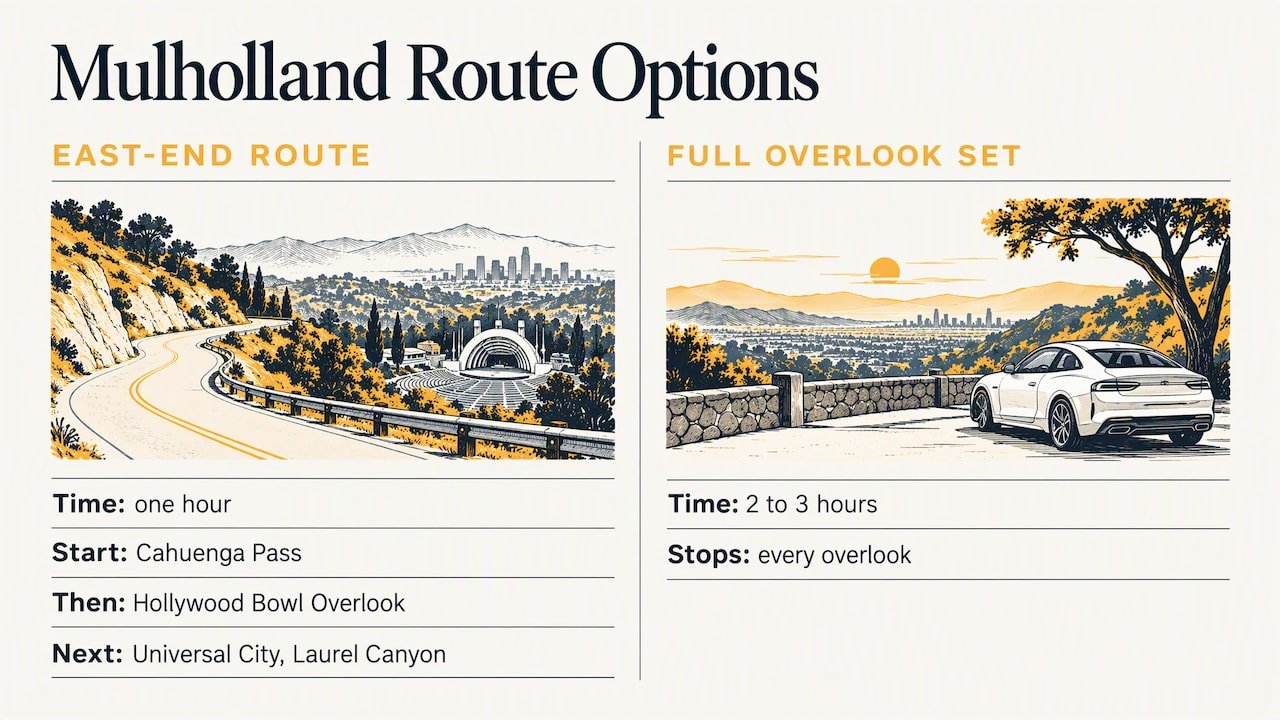
If you only have an hour, the most scenic section is the east end: from the 101 at Cahuenga Pass, up to the Hollywood Bowl Overlook, then west to Universal City and Laurel Canyon. This gives you both sides of the ridge, the Hollywood Sign angle and the Valley. If you have two to three hours, you can stop at every overlook; one guide estimates 2 to 3 hours for the full set in one drive.
The famous 17-Mile Drive is a different road entirely. It is a private coastal route in Pebble Beach, hundreds of miles north, and has nothing to do with Mulholland.
When to go
The overlooks are free and open daily from sunrise to sunset, with limited parking in each lot. That shapes your timing.
- Morning, on a weekday: easiest parking and the clearest air. Haze often builds later in the day.
- Late afternoon: warm light on downtown and the Valley, but the lots fill up. Plan to arrive an hour early.
- Sunset: the best colors, and the most crowded. Remember the lots close at dark, so do not plan to linger after sunset.
- After a rain or a windy cold front: the best visibility of the year. Clear days are when the ocean and Catalina come into view.
If you want night views of the city lights, a different format works better than a parking-lot overlook after dark. A night helicopter flight is one option, covered below.
Driving Mulholland safely
The road is narrow, winding and has blind curves. Locals treat it with respect, and so should you.
- Prefer the Valley side. The overlooks on the north side let you turn in without crossing oncoming traffic, which Time Out’s local advice points to as the safer approach.
- Do not stop on blind curves. Use only the lots and clearly signed pull-outs. Where street parking is allowed, observe posted signs and watch for cars around bends.
- Stay on pavement. About eight miles of the corridor between the 405 and Woodland Hills remain unpaved and are subject to closure. If you are in a low-clearance or rental sports car, stay on the paved part east of the 405. The county’s Dirt Mulholland trail guide describes access from Reseda Boulevard for those who want to explore it on foot or bike.
- Check fire conditions. California State Parks publishes closure protocols for Red Flag Warnings in the Santa Monica Mountains. On those days the guidance is to avoid backcountry areas, and trails and park facilities may close even if roadside overlooks stay open. Before you leave on a hot, dry or windy day, check the MRCA and National Park Service status pages.
Add the hikes and the Hollywood Sign
Mulholland is the doorway to a lot of the Santa Monica Mountains. Runyon Canyon Park is a 130-acre park two blocks from Hollywood Boulevard that reaches north to Mulholland, with entrances on Fuller Avenue, Vista Street and off Mulholland. Fryman Canyon is reachable from the Nancy Hoover Pohl Overlook.
The Hollywood Sign is the other question. From Mulholland you see it at a distance, which is excellent for context but not for a close photo. If you want to compare angles, read our Hollywood Sign viewing guide and how to see the Hollywood Sign the best way. Parking near the sign is tight, which we cover in our Hollywood Sign parking piece.
Our perspective
We run tours in Los Angeles every day, and Mulholland comes up in almost every conversation with guests. Our view is simple: the overlooks are the best free perspective on the city, and you should use them. Street-level landmarks such as the Walk of Fame show you details. The ridge shows you scale, and it is the thing first-time visitors say they did not expect.
But driving it yourself has real costs. You are watching blind curves instead of the view, you are hunting for a space in a small lot, and you are the designated driver for everyone in the car. That is where a guided format helps. With a local guide and small groups, someone else handles the road, and you spend the time looking out the window and asking questions about what you see.
Our advice for a first day in L.A.: use Mulholland for one early or golden-hour stop, and use the rest of the day for what you cannot see from a ridge: the sign up close, the celebrity neighborhoods, the coast. If you are planning the whole trip, our Hollywood itinerary guide shows how we would sequence it.
— vincent
Ways to see the view without driving it yourself
There are three formats we offer that fit this view-hungry visitor.
- The Hollywood Sign Tour: a guided small-group trip focused on the sign, listed at 199 $ per group. See the Hollywood Sign Tour.
- Helicopter tours: the Hollywood Sign flight is 10 minutes at 159 $ per person, Hollywood Celeb is 20 minutes at 199 $ per person, and the Deluxe flight is 60 minutes at 449 $ per person. A sunset or night experience adds 50 $, a photo 20 $ and a 360 VR video 60 $. Browse the helicopter tours.
- Exotic car drives: the Ferrari California Tour and the Cybertruck Tour start at 89 $, the Spyder Tour at 69 $ and the Lamborghini Huracan Spyder Tour at 149 $. If you want to drive a special car on winding roads, see the exotic car tours.
If you would rather see the stars’ neighborhoods than the ridgeline, the Celebrity Homes Tour covers that, with live guides and audio guides in more than 11 languages.
A simple half-day plan
- Start early (about 8 a.m.). Drive to the Jerome C. Daniel Overlook. Walk the short trail for the full view of the Bowl, the sign and downtown.
- Head west to the Universal City Overlook. Look at the Valley and the Verdugo Hills. Easy in and out.
- Continue to Nancy Hoover Pohl. Take a short walk into Fryman Canyon if everyone has energy.
- Come back down for lunch, then spend the afternoon on the sign, Hollywood Boulevard, or a tour. Our Hollywood Boulevard attractions guide helps you choose.
If you are interested in movie history, many of these roads and overlooks have appeared on screen. Our Los Angeles filming location guide covers how to visit them.
Frequently asked questions
What is the most scenic part of Mulholland Drive?
The east end near Hollywood is the most dramatic. The Jerome C. Daniel Overlook above the Hollywood Bowl has views of the Bowl, downtown, the Hollywood Sign and Griffith Observatory. Continue west for the Valley views from the north-side overlooks.
Is it free to stop at the Mulholland overlooks?
Yes. The overlooks are free and generally open from sunrise to sunset, according to one visitor guide. The lots are small, so expect to wait at busy times.
Where is the famous 17-Mile Drive?
It is in Pebble Beach, California, not in Los Angeles. It is a separate private coastal road, very different from Mulholland’s ridgeline.
Can I drive all of Mulholland Drive?
Not in a standard car. About eight miles between the 405 and Woodland Hills are unpaved and subject to closure, per the MRCA. Stick to the paved sections east of the 405.
Are the overlooks open during a Red Flag Warning?
Roadside overlooks may stay accessible, but trails and park areas can close. Check the state park protocol and the MRCA or National Park Service pages before heading out.
Sources
- MRCA: Mulholland Scenic Parkway and Corridor
- MRCA: Jerome C. Daniel Overlook above the Hollywood Bowl
- MRCA: Nancy Hoover Pohl Overlook
- Lamountains: Hollywood Bowl Overlook (Jerome C. Daniel)
- Lamountains: Universal City Overlook
- Lamountains: Nancy Hoover Pohl Overlook
- Lamountains: Runyon Canyon Park
- Time Out: Mulholland Drive Overlooks for a Joyride Above Hollywood
- California By Choice: Mulholland Scenic Parkway and Corridor
- California State Parks: Red Flag Warning Park Closure Protocols, March 2026
- County of Los Angeles: Mulholland Drive Trail quick guide