
The best times to drive in Los Angeles are mid-morning to early afternoon on weekdays (roughly 9:00 AM to 2:30 PM), very early in the morning, and late in the evening. The worst are the weekday commute windows and, surprisingly to many visitors, Saturday and Sunday afternoons. Below you will find the official numbers, the days that run fastest and slowest, and a practical way to plan a sightseeing day so traffic does not eat it.
TL;DR
- Caltrans measured the weekday morning peak at 6:30 AM to 9:00 AM and the evening peak at 2:30 PM to 6:00 PM in the second quarter of 2024.
- Weekend traffic peaks from 1:00 PM to 5:00 PM on both Saturday and Sunday, so “the weekend is quiet” is not a safe assumption.
- The gap between the two weekday peaks (late morning to early afternoon) is your best window for crossing town.
- One crash can jam any freeway at any hour, so build slack into every drive between attractions.
- If you would rather not spend your vacation behind the wheel, a guided tour lets someone else handle the route.
Table of Contents
- When rush hour actually happens in Los Angeles
- The best days (and the worst) to drive
- Weekends are not a free pass
- Which freeways cause the most trouble
- How to plan a driving day between attractions
- Checking conditions before you leave
- Seeing LA without fighting the traffic
- Our perspective
- Book a day that works with the traffic
- FAQ
- Sources
When rush hour actually happens in Los Angeles
Forget the idea of a single “rush hour.” Los Angeles has long, stretched-out commute periods, and they start earlier and end sooner than most visitors expect.
Caltrans District 7, which covers Los Angeles and Ventura counties, publishes a quarterly Mobility Performance Report. In its second quarter 2024 report, the weekday morning peak period ran from 6:30 AM to 9:00 AM, with the single worst hour at 8:00 AM. The evening peak period ran from 2:30 PM to 6:00 PM, with the worst hour at 5:00 PM.
Two things stand out:
- The evening peak starts in the middle of the afternoon. If you plan to leave downtown or the Westside at 3:00 PM thinking you are ahead of the crowd, you are already inside the peak.
- The morning peak is early. Leaving at 6:00 AM puts you just ahead of it. Leaving at 8:00 AM puts you in the worst hour of the morning.
People often quote wider windows, such as 7:00 AM to 10:00 AM and 3:00 PM to 7:00 PM. That is not wrong as a feel for the city. Congestion lingers on the edges of the official peak, especially on the busiest corridors. A 2021 Los Angeles Times analysis of post-pandemic traffic found that the evening crush was clearing out by about 7:00 PM, earlier than before the pandemic. As a planning rule, treat 6:30 AM to 9:30 AM and 2:30 PM to 7:00 PM as the hours to avoid if you can.
A quick reference by time of day
| Time (weekdays) | What to expect | Good for driving? |
|---|---|---|
| Before 6:30 AM | Roads still open | Yes |
| 6:30 to 9:00 AM | Morning peak, worst at 8:00 AM | Avoid if possible |
| 9:00 AM to 2:30 PM | Between the two peaks | Best window for crossing town |
| 2:30 to 6:00 PM | Evening peak, worst at 5:00 PM | Avoid if possible |
| 6:00 to 7:00 PM | Easing, but still slow on busy freeways | Fair |
| After 7:00 PM | Mostly cleared | Good |
The windows between the peaks come straight from the Caltrans peak periods. Treat them as a starting point, not a promise. Los Angeles rarely has a truly empty freeway, and a single stalled car or collision can slow a route at any hour.
The best days (and the worst) to drive
Time of day is only half the picture. The day of the week changes things too.
The USC Crosstown team analyzed freeway speeds and published the best and worst days to commute on LA freeways through LAist. The data covers 2018, so the exact speeds will have shifted, but the pattern is a useful guide:
- Monday evenings were generally the fastest for commutes.
- Thursday evenings were the slowest.
- Friday morning was the worst time to take the 405 North between the 10 and the 118.
The lesson for visitors: if your schedule is flexible, put your longest cross-town drives on a Monday or early in the week, and keep Thursday and Friday for stops that are close together. Locals know the Thursday evening trap well, and a hotel concierge will usually confirm it.
Weekends are not a free pass
This is the part that surprises first-time visitors. Caltrans found that weekend traffic peaks at 3:00 PM, with the peak period running from 1:00 PM to 5:00 PM on both Saturday and Sunday, according to the same District 7 report.
That makes sense once you picture the city. Weekends are when Angelenos head for the beach, Griffith Park, the malls, stadiums and concerts, and when tourists do their big sightseeing days. Beach routes and the roads around Hollywood Boulevard fill up well before sunset.
A better weekend plan:
- Do the most popular, most car-dependent stops in the morning, before 1:00 PM.
- Eat a long lunch or visit an indoor attraction during the 1:00 to 5:00 PM peak.
- Drive again in the early evening, when the weekend peak has passed.
Which freeways cause the most trouble
Not every road is equal. In the Caltrans District 7 report, three freeways stood out: the I-405, the I-10 and the I-5 together accounted for about 47% of total delay measured at the 35-mph threshold. In plain terms, these are the routes where a small problem becomes a big one.
What that means for a visitor:
- The 405 links the airport area, the Westside, the Valley and the South Bay. If your plan includes crossing the Sepulveda Pass between the Westside and the San Fernando Valley, do it outside the peak windows.
- The 10 is the main east-west route through Santa Monica, mid-city and downtown. A Santa Monica to downtown trip at 5:00 PM is a classic way to lose an hour.
- The 5 carries long-distance traffic and passes close to downtown, Dodger Stadium and Griffith Park.
The 101 through Hollywood is also busy. Caltrans has an ongoing pavement project at the Cahuenga Pass, and lane and connector closures there are generally limited to nighttime hours, 9 p.m. to 6 a.m., although some ramps can close during the day as well. If you plan a late dinner or a night out around Hollywood, check for closures first.
How to plan a driving day between attractions
Los Angeles is spread out. Hollywood, Beverly Hills, Santa Monica, downtown and Griffith Park are each a short hop on a map and a long haul in traffic. Here is a simple method.
- Group stops by area. Spend one block of time in Hollywood, another on the Westside, another downtown. Zigzagging is what ruins itineraries.
- Drive the long legs in the gap. Aim to cross town between 9:00 AM and 2:30 PM on weekdays.
- Be at your farthest stop before the evening peak. Then you are moving toward your hotel when the roads begin to fill, or you are eating dinner while the worst passes.
- Have an alternate route. Discover Los Angeles advises that when freeways are jammed, drivers should consider surface streets (any street that is not a freeway or limited-access highway) as alternates. A navigation app that reroutes live makes this easy.
- Add a buffer. Whatever the app says, add 20 to 30 minutes if you have a timed reservation.
If you want more help with the order of your stops, our Hollywood itinerary planning guide and the tour timing guide walk through realistic days.
Checking conditions before you leave
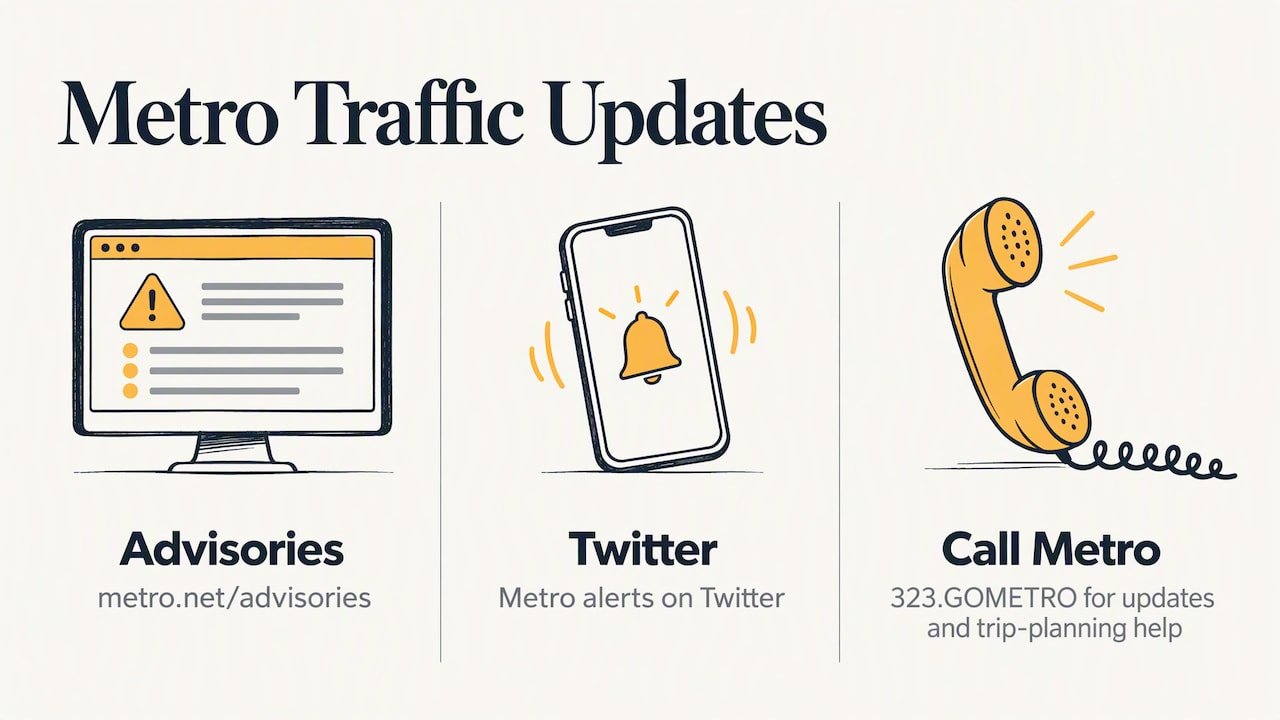
Build the habit of checking traffic right before you get in the car, because conditions in LA change quickly. Metro, the regional transit agency, says that construction is dynamic and that closure schedules can change without notice because of work progress and weather, as stated on its freeway lane closure advisory. The same page lists ways to get updates: the metro.net/advisories page, Metro’s alerts on Twitter, or a call to 323.GOMETRO for updates and trip-planning help.
Freeway closures are often scheduled overnight, and they are announced in advance. If you have an early morning airport run or a late arrival, look at the current Metro advisories first, since a closed on-ramp can add a lot to a trip.
For a wider sense of the calendar, our month-by-month guide to the best time to visit Los Angeles covers seasons, crowds and events that can change how busy the roads feel.
Seeing LA without fighting the traffic
The honest truth is that many visitors do not want to learn the Sepulveda Pass. They want to see the Hollywood Sign, a few celebrity neighborhoods and the coast, and then relax. Here are the practical options.
- Group tours with a local driver. Someone else navigates, you look out the window. Our Hollywood to Santa Monica Tour (4.5 hours) is $79 per person and connects two areas that are a frustrating drive at the wrong hour.
- Short, focused tours. Our Hollywood Sign Tour is $199 per group. The usual headache at the sign is finding a place to park, which we cover in our Hollywood Sign parking guide.
- Skipping the roads. Our helicopter tours start at $159 per person for the 10-minute Hollywood Sign flight, with longer coastline and downtown options.
- Driving something fun. If you do want to be behind the wheel, our exotic car tours start from $69 for the Spyder Tour, with the Ferrari California and Cybertruck from $89 and the Lamborghini Huracan Spyder from $149.
- No car at all. Our guide to Los Angeles without a car covers how to get around on transit and tours.
If you do plan to drive yourself for scenery, our scenic drives guide helps you pick routes that suit the time of day.
Our perspective
Every week we meet guests who spent the first half of their trip stuck in a rental car, tired and behind schedule. LA traffic is not a flaw in the city. It is a fact of the city, and the smartest answer is to plan around it or hand the driving to someone who does it every day.
That is why we built our tours the way we did. Small groups, a live local guide, onboard screens with exclusive video content and audio guides in more than 11 languages mean the ride itself is part of the experience, not the price you pay to get to it. You are looking at celebrity neighborhoods and landmarks while the road is someone else’s job.
Our advice is simple. Book your big sightseeing outing for a time when you want to be rested and curious, not when you are racing the clock. If you want an even more private pace, a private tour lets you set the stops with your guide. And if you do want to drive, our exotic car rides put you in a Ferrari, a Lamborghini or a Cybertruck for the fun part of the city.
vincent
Book a day that works with the traffic
If you would rather spend your time at the sights than on the freeway, take a look at our tours. Pick a small-group bus tour, a private outing, a helicopter flight or an exotic car ride, and we will handle the planning around the city.
See all of our bus tours or read how to book Los Angeles tours the smart way before you choose.
FAQ
What are the peak traffic hours in Los Angeles?
On weekdays, Caltrans measured the morning peak at 6:30 AM to 9:00 AM and the evening peak at 2:30 PM to 6:00 PM in the second quarter of 2024. The worst single hours were 8:00 AM and 5:00 PM. Roads can stay slow on the edges of those windows, so give yourself extra room.
What is the best time to avoid rush hour in LA?
On weekdays, the gap between the peaks, from about 9:00 AM to 2:30 PM, is your best bet, along with the early morning before 6:30 AM and the evening after about 7:00 PM. Even then, a crash or road work can slow any route, so check a live traffic app before leaving.
Is LA traffic bad on weekends?
Yes, especially in the afternoon. Caltrans found that Saturday and Sunday traffic peaks around 3:00 PM, with the peak period running from 1:00 PM to 5:00 PM. Plan popular, car-dependent stops for the morning and use the afternoon for indoor activities.
Which freeways have the worst traffic?
In Caltrans District 7, the I-405, I-10 and I-5 together produced about 47% of the delay measured at the 35-mph threshold. If your route uses one of them, avoid the peak windows and have a surface-street alternative ready.
Do I need to rent a car to visit Los Angeles?
Not necessarily. Many visitors cover the main sights with guided tours, transit and ride services, and it saves the stress of parking and rush hour. Our guide to visiting Los Angeles without a car explains the options.
Sources
- Caltrans District 07 Mobility Performance Report, second quarter 2024
- Los Angeles Times: Post-COVID L.A. traffic analysis, has rush hour changed?
- LAist: Best and worst days to commute on LA freeways
- Caltrans: U.S. 101 Cahuenga Pass Pavement Rehabilitation
- Discover Los Angeles: The Guide to Driving in Los Angeles
- LA Metro: Freeway lane closure advisory