
The best time to visit Los Angeles is spring (March to May) or fall (September to November). Days are comfortable, crowds are lighter than in summer, and the sightseeing you came for, the Hollywood Sign, Sunset Boulevard, Beverly Hills, the coast, is at its easiest. But LA is a place where almost every month works if you plan around it, so this guide goes season by season and then gets specific about the Hollywood Sign and guided tours.
TL;DR
- Best overall: March to May and September to November, when the weather is comfortable and crowds are more manageable.
- Rainy season runs November through April; the dry season runs May through October, and summer and early fall can get hot.
- Coastal mornings in early summer can be gray (“June Gloom”), so pack layers even in a heat wave.
- For the Hollywood Sign, aim for a clear day, ideally just after rain has cleared the haze.
- Book tours early in the day for the clearest views and the lightest traffic, whatever the season.
Table of Contents
- How Los Angeles seasons really work
- Los Angeles weather by month
- Spring (March to May): the safe bet
- Summer (June to August): hot, sunny, busy
- Fall (September to November): our favorite window
- Winter (December to February): cooler, cheaper, clearer after storms
- Best time for the Hollywood Sign
- Best time for a Hollywood tour
- Perspective: how we plan around the weather
- Which tour fits which season
- Crowds, prices and the shoulder-season advantage
- How long do you need?
- FAQ
- Sources
How Los Angeles seasons really work
Forget the four-season model. Los Angeles has a rainy season from November through April and a dry season from May through October. Spring and fall bring mild sightseeing days, winter can bring storms, and summer and early fall can be hot.
The second thing to know is that “LA weather” is not one number. Average temperatures vary a lot by neighborhood: summer highs can differ by about 20°F between the coast and the west San Fernando Valley. A beach morning in Santa Monica and an afternoon in the Valley can feel like two different cities. If your plans cross the basin, which most sightseeing days do, dress for the widest range you will meet.
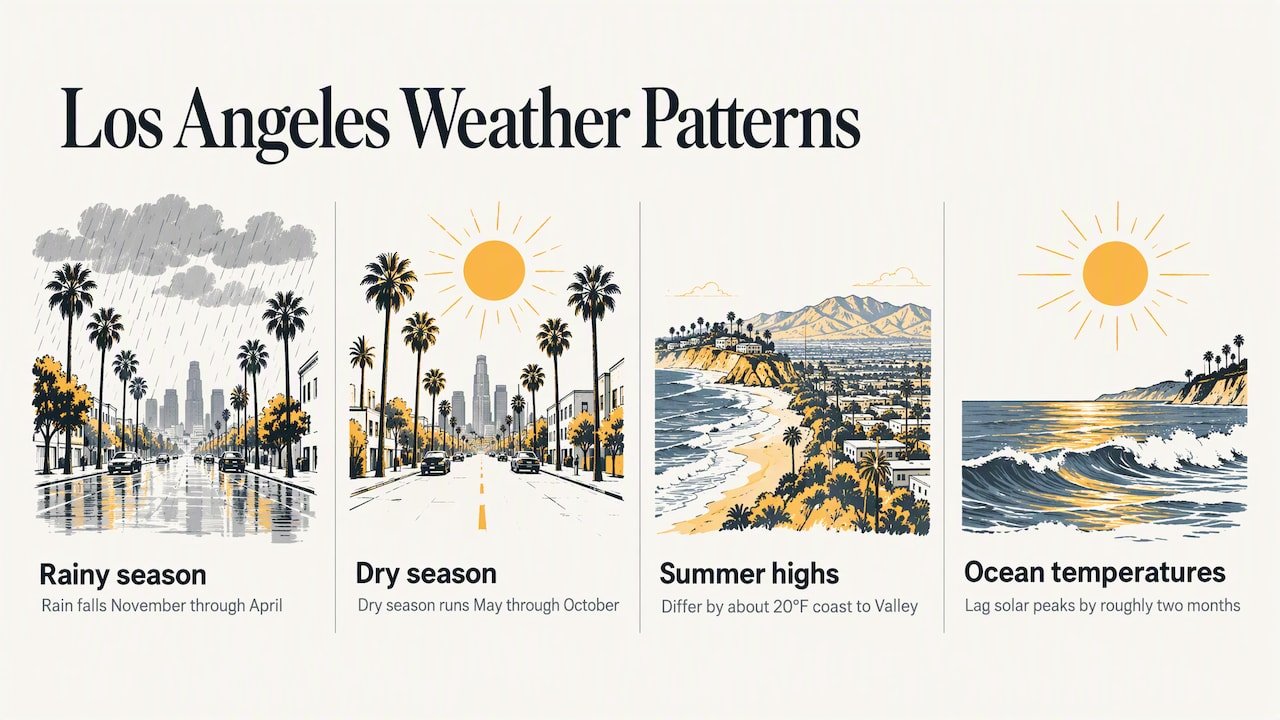
The ocean adds its own delay. Local forecasters note that ocean temperatures warm and cool roughly two months after the solar peaks. That is why the water and the coast often feel best in late summer and early fall rather than in June.
Los Angeles weather by month
Downtown Los Angeles is the standard reference point. According to 1991–2020 normals, mean temperatures run from 57.8°F in December to 74.7°F in August, and the same table shows February rainfall averaging 3.64 inches against 0.00 inches in August. Those two extremes frame the whole year: a cool, occasionally wet winter and a hot, bone-dry late summer.
Here is how that plays out for a visitor, month by month, in plain terms.
| Months | What to expect | Visitor verdict |
|---|---|---|
| December to February | Coolest stretch of the year (December is the coldest month Downtown) and the heart of the rainy season, with February among the wettest | Good for fewer sun-seekers and sharp views after storms; carry a rain layer |
| March to May | Rainy season fades into the dry season; mild, comfortable days | Best all-around window |
| June to August | Dry, sunny, hot inland; gray coastal mornings possible | Great for beaches, busiest for crowds; start days early |
| September to November | Dry season continues into October, with rain returning in November; warm, often hot early on, then mellower | Best combination of weather and atmosphere |
A caution on the table: it describes typical patterns, not forecasts. Individual years differ, and the 2026–27 El Niño outlook is one reason winter rainfall can swing from the average. Check a forecast a few days before you fly.
Spring (March to May): the safe bet
If you can only choose one window, choose this one. U.S. News names March to May and September to November as the best times to visit, citing comfortable weather and more manageable crowds. AAA adds that shoulder-season visits bring fewer crowds, better affordability and a lighter footprint, because fewer resources are used.
Spring is also the season for being outside on your feet. The Los Angeles County Department of Parks and Recreation recommends spring for outdoor activities like hiking because cooler temperatures make trails easier than in summer or early fall. That matters if you want to walk toward the Hollywood Sign rather than just look at it from a distance; our Hollywood Sign hike guide covers the trails and distances.
The trade-off: early spring can still see a late storm, and spring-break weeks and holidays push up hotel prices and lines at the big attractions. Mid-week visits in April and May are the sweet spot.
Summer (June to August): hot, sunny, busy
Summer in LA is defined by clear skies and hot temperatures, though coastal areas may have overcast mornings known as June Gloom. Planning for that gloom is the easiest way to avoid a disappointing first day: if the beach is gray at 9 a.m., it often burns off by midday, but not always, and photos from the coast before then can look flat.
One scoring model that rates rain-free, comfortable weather for general outdoor tourism finds that late May to mid-October is highly favorable. So summer is not a bad choice for weather. It is a choice about crowds and heat. If you go:
- Do your outdoor sightseeing early and keep the middle of the day for museums, shopping or air-conditioned transport.
- Carry water and sun protection to every viewpoint and attraction.
- Expect the Hollywood Sign area and Walk of Fame to be at their most crowded.
- Look at our packing guide for fog, heat and hikes so you are not caught in a sweatshirt at noon or a T-shirt at 8 a.m.
Fall (September to November): our favorite window
Fall is where the weather and the mood line up. The dry season carries on into October, the heat of high summer starts to ease, and the ocean has caught up with summer’s warmth. September is also baseball pennant-race season, which makes game days at Dodger Stadium a great local experience, although the weather in early fall can still be hot, so treat September like late summer for clothing.
November is the transition: the rainy season starts again, and a storm day or two is possible, but a rinsed-out sky is a gift for views, as the Hollywood Sign section below explains. Fall also overlaps with fire season risk in the hills, so on a windy, dry day check conditions before planning trail time and be ready to be flexible.
Winter (December to February): cooler, cheaper, clearer after storms
Winter is the quietest period for most attractions, and December is the coolest month Downtown. You will not need a heavy coat, but you will want a light jacket in the evening and a waterproof layer for storm days. The trade-off is simple: you may lose a day to rain. The upside is the fresh, sharp air after it.
If you visit in winter, build a flexible plan. Put indoor stops (museums, studio-related visits, dining) on the rainy days and save viewpoints and tours for the first clear day after a storm.
Best time for the Hollywood Sign
Searches like “Hollywood Sign weather” really come down to one thing: visibility. LA’s air can be hazy, and after significant rain the air is cleared of haze and smog, giving exceptionally clear views across the metropolis. So the best days for the sign and the city views behind it are typically the day after a rainstorm, with the next best being any clear morning.
Practical timing rules we give guests:
- Go early. Morning light is flatter and softer on the sign, crowds are thinner and traffic around the hills is lighter.
- Check the sky, not just the temperature. A 75°F day with haze is a worse photo day than a 62°F day after rain.
- Plan your approach. Griffith Park has 50 miles of hiking trails leading to views of the city and the sign, but trails are far more pleasant in spring than in a summer afternoon.
- Avoid the parking hunt. Streets near the best viewpoints are tight; see our notes on Hollywood Sign parking, or use a guided tour so someone else handles it.
For more on angles and viewpoints, read our Hollywood Sign viewing guide and how to see the sign the best way.
Best time for a Hollywood tour
The tour itself is the more forgiving part of a trip. A small-group bus with a live guide means you are not walking in July heat or navigating freeway traffic yourself, and the onboard screens and audio keep the stories coming whatever the sky looks like. A few timing tips:
- Morning departures give the clearest views and lighter traffic in every season. Our tour timing guide goes through it hour by hour.
- Afternoons in spring and fall are comfortable for celebrity-home routes, where you spend more time looking out of the vehicle than walking.
- Summer coastal mornings may be gray, so a Hollywood or Beverly Hills route often beats a beach route before noon.
- After rain, pick the sign and viewpoint-heavy itineraries.
If you are traveling without a car, you can still cover a lot of ground; see our guide to Los Angeles without a car.
Perspective: how we plan around the weather
We run LA sightseeing every day of the year, and the pattern is consistent. Guests who book for spring or fall are rarely disappointed, but the best days are not tied to a month: they are tied to the sky. We tell guests to be flexible by a day if they can, to pick the morning slot if the view matters, and to dress in layers for a city where the coast and the valley can feel 20 degrees apart. In summer we steer people toward early starts and air-conditioned vehicles; in winter we watch the forecast and move viewpoint-heavy routes to the clearest day.
Our small-group format helps here: with fewer guests on board, the guide can adjust the order of stops to follow the light and the haze, and private bookings give you even more control of the timing. If your dates are fixed, the weather is rarely a reason to cancel. It is a reason to choose the right route for the day.
— vincent
Which tour fits which season
When you are ready to book, this is how we would match the season to the experience.
| Season | Good fit | Why |
|---|---|---|
| Spring | Hollywood Sign Tour, $199 per group | Mild days and good light for viewpoints |
| Summer | Hollywood to Santa Monica Tour (4.5 hr), $79 per person | Shaded, seated transport from the city to the coast, with an early start to beat the gloom |
| Fall | Celebrity Homes Tour | Comfortable afternoons for slow neighborhood drives |
| Winter, post-rain | Helicopter tours, such as the 10-minute Hollywood Sign flight at $159 per person | Washed-clear air makes the aerial view at its best |
If you want to drive something memorable on a perfect day, our exotic car tours start from $69 for the Spyder Tour. Topless-car drives are best on a mild, dry day in spring or fall. On our helicopter flights, a sunset or night add-on is $50 and photos are $20, which is worth considering when the evening sky is clear.
Not sure where to begin? Our guide to the best Los Angeles sightseeing packages compares the options, and how to book VIP sightseeing walks through booking.
Crowds, prices and the shoulder-season advantage
AAA’s point about shoulder seasons is practical: fewer crowds and better affordability go together. Spring and fall tend to offer a better value on lodging than peak summer. A few ways to stretch the advantage:
- Visit Tuesday to Thursday when possible; weekends are busiest at every major stop.
- Avoid major holiday weeks if you want quiet viewpoints.
- Book the morning departure and keep the afternoon free for the pool, the beach or a long lunch.
- Leave a spare day in the itinerary for weather.
How long do you need?
Three full days is a comfortable minimum for the core: Hollywood, Beverly Hills and the coast. Five lets you add a museum day, a theme park or a hike. Whatever your length, put the viewpoint-driven day in the middle, so you can swap it with an indoor day if the sky is poor.
FAQ
When is the best time of year to go to LA?
March to May and September to November are widely recommended, since they avoid both the harshest heat and the heaviest summer tourist traffic. Spring is the best fit for hiking and being outside, while fall adds warm days and a lively local atmosphere.
What is the best weather in Los Angeles?
The dry season, May through October, has the most reliable sunshine, and spring and fall are the most comfortable. Heat is highest in summer and early fall, especially inland, while coastal areas can be overcast in the mornings in June.
When is the best time to see the Hollywood Sign?
The clearest views come on a morning after rain, when the haze has been washed from the air. If your dates are fixed, go early in the day in any season for softer light and lighter crowds.
Is it worth visiting LA in winter?
Yes, if you are flexible. December is the coolest month, and the rainy season runs through April, but storms are intermittent and the clear days that follow give some of the best city views of the year. Plan indoor activities as a backup.
Sources
- Best Times to Visit Los Angeles, U.S. News Travel
- The Best Time to Visit Los Angeles, AAA TripCanvas
- Current and Past Temperature/Rainfall Normals, Downtown Los Angeles, LA Almanac
- Los Angeles Weather by Month, WeatherLA
- Climate of Los Angeles
- Los Angeles Climate, Weather By Month, WeatherSpark
- Facts About Los Angeles, Discover Los Angeles